Sealcoating Fargo Call (701) 638-9796
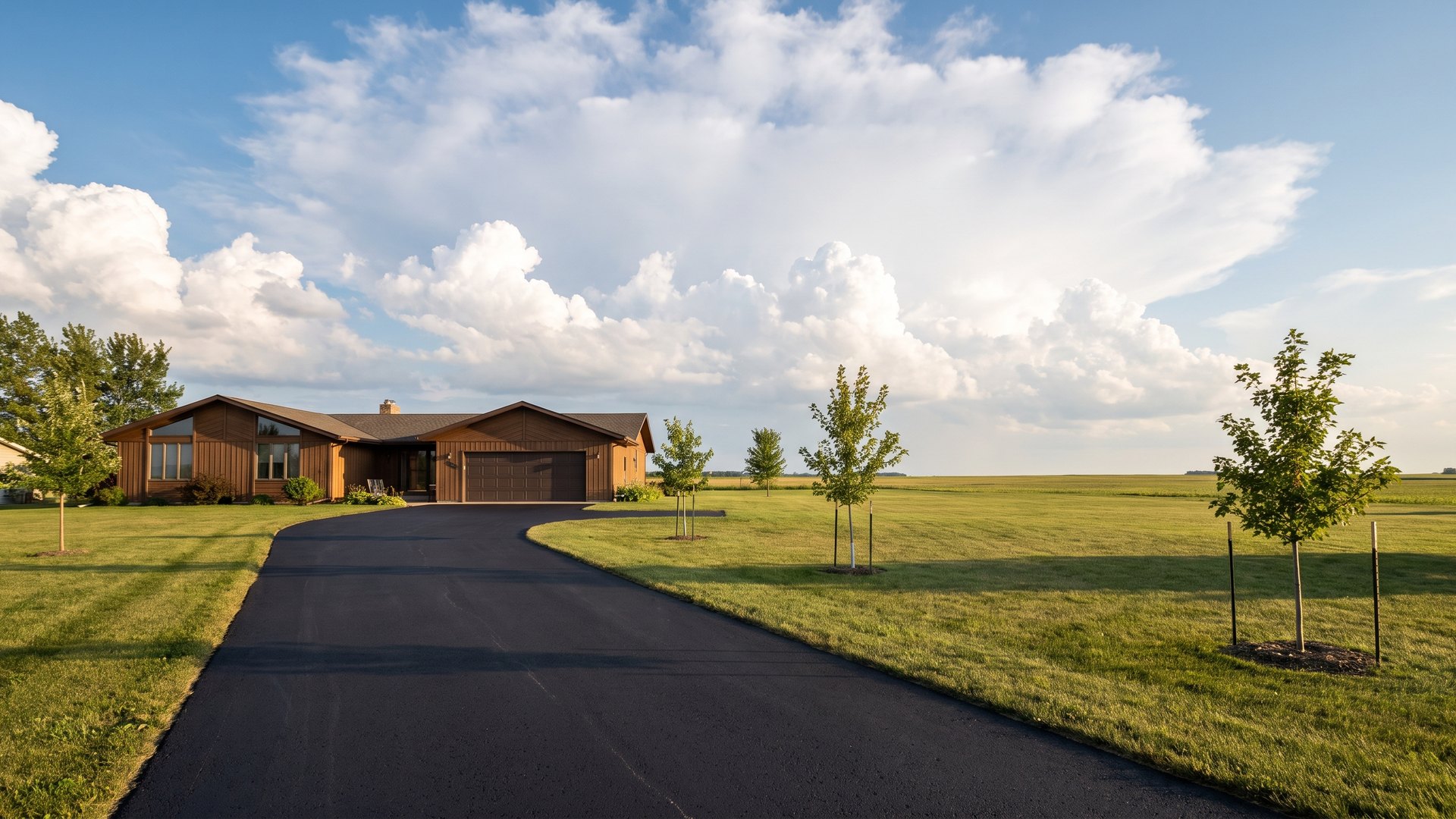
Towering white clouds rise over flat open land as a long, curving driveway of fresh sealcoat sweeps up to a brown wood-sided ranch

Sealcoating Fargo

(701) 638-9796

Free Fargo-Moorhead quotes for driveways and lots.

Asphalt Sealcoating in Fargo, Timed to a Short Summer

Hector International Airport's median frost dates leave about 142 days between the last spring freeze and the first fall one. Sealer has to go down and cure inside that gap, while crack filling claims the cool weeks on either side of it.

  • Median last freeze May 8, first freeze Sept. 29 at Hector airport (NOAA 1991-2020)
  • About 84 freeze-thaw days a year, 31 of them in March and April alone
  • Coal-tar sealer is still legal in North Dakota; Minnesota banned it in 2014
Red River Valley

Asphalt on a short, cold calendar

Blacktop in the Red River Valley gets a short working year. NOAA's 1991-2020 normals for Hector International Airport, which lies roughly three miles northwest of the downtown blocks, place the median last spring freeze on May 8 and the median first fall freeze on September 29. Sealing, and most paving, has to land between those dates, and the stretch when sealer cures the way its label intends is narrower still. Outside that stretch the pavement is frozen, thawing, or wet from snowmelt that arrives all at once. Most of what goes wrong with asphalt here traces back to that compressed calendar.

Seal coating means spreading a thin skin of asphalt emulsion or acrylic binder, usually loaded with sand, across the pavement with squeegees or a spray wand. In this climate its job is narrow but worth doing. It closes the top of the mat so meltwater and rain stop soaking in, and it slows the drying-out of the binder that turns black asphalt gray and brittle. No coat can do anything about a base that has heaved or a crack wide enough to swallow a coin. Good driveway sealing here therefore starts with repairs in the cool shoulder weeks and finishes with a coat laid in the warm middle of summer.

The metro also straddles a state line, and the rules change at the river. Fargo, West Fargo and Horace are in North Dakota, where no statewide or local coal-tar sealer ban appears on the national tracking list. Moorhead and Dilworth are in Minnesota, which has barred both selling and applying coal-tar sealants since January 1, 2014. Snow rules, permit offices and frost-depth requirements differ as well, and each town page, beginning with sealcoating in Moorhead, sets out the local version.

This is an independent referral site. Observed price ranges sit on the cost page, each climate figure is tied to NOAA or a government source, and quote requests are forwarded to independent contractors in the Fargo-Moorhead area. It performs none of the work itself. The frost and flood data page pairs every number used here with the source it came from, so the arithmetic can be checked.

Free quote

Fields marked * are required.

Fast response during business hours. No obligation.

The work

Seven asphalt jobs, each timed to the Fargo frost dates

Looking out from the garage, new sealcoat covers the near half of the drive, weathered gray asphalt running toward the road and fields

Driveway Sealcoating

A sanded asphalt-emulsion or acrylic coat over a cleaned, crack-filled home driveway, laid in the June to August stretch when Fargo nights stay warm enough for sealer to cure.

Typical: Two-car drives mostly $210 - $860; about $0.30 - $2.10 a sq ft

Evening sun glints off coarse gray asphalt crossed by a wide, flat band of black crack filler, green flatland running to the horizon

Crack Filling

Hot rubberized filler worked into transverse, edge and seam cracks in the cool weeks of April and October, when cold air holds the cracks open and the filler can fill them completely.

Typical: $0.50 - $3.00 a linear ft; whole driveways mostly $100 - $400

A narrow trench patch of darker asphalt spans a gray driveway leading to a beige ranch with a white garage door

Asphalt Patching

Cold patch to get through the thaw, then saw-cut hot-mix patches once the ground drains, for the potholes and soft spots that the March and April freeze-thaw swings leave behind.

Typical: $100 - $500 for a pothole or small patch; saw-cut repairs $4 - $12 a sq ft

Worn yellow lines on faded gray pavement stop at a crisp edge of new black sealer before a long tan metal building

Parking Lot Sealcoating

Apartment, retail and church lots cleaned, crack-sealed and coated in sections, scheduled around tenants and the July and August nights that let sealer cure, then restriped.

Typical: Basic coat $0.14 - $0.50 a sq ft; more with crack sealing and striping

Bright new stall lines fan across fresh black sealcoat along a curb facing open grassland at sundown

Line Striping

Repainting after a seal coat or a winter of plowing: stalls, arrows, fire lanes and accessible spaces, with the accessible count checked against the 2010 ADA Standards every time a lot is restriped.

Typical: About $4 - $5 a stall; 30 to 50 stall lots roughly $500 - $1,200

A shelterbelt of spruce and leafy trees borders a resealed church lot with fresh stall lines and young trees in curbed islands

Asphalt Maintenance Plans

One schedule on paper for a drive or lot, several years long: a spring walk after frost-out, crack passes in April and October, patching after the thaw and a seal coat every two to three summers.

Typical: By task: lot sealcoat $0.14 - $0.50 per square foot and crack filling $0.50 - $3.00 per linear foot

A blue-gray roller rests on the lawn beside a new asphalt driveway to a beige ranch under towering sunset clouds

Asphalt Paving

Driveways and small lots paved new or replaced, on a base sized for deep frost and wet clay, placed between May and September and left to cure before the first seal.

Typical: $5 - $15 a sq ft new or replacement; overlays $1 - $3 a sq ft

What a Fargo owner gets from reading here first

Numbers from Hector, not a template

The climate figures come from NOAA's 1991-2020 normals for Hector International Airport and the flood history from the National Weather Service gauge on the Red River at Fargo. The advice is fitted to those numbers: when the frost is usually out, which weeks suit crack filling, and how late a coat can go down and still cure before the first freeze. Anyone can check them on the data page.

Prices published before the phone call

The cost page carries observed ranges for five kinds of work, from sealing and crack filling to patching, striping and new paving, each tied to the guide it came from, including Homeblue's sealing estimate for Fargo. Seeing the spread first makes a written quote easier to read, and it shows when a price leaves out crack repair or includes work the pavement does not need yet.

Both banks of the Red covered

A crew sealing in Moorhead or Dilworth works under Minnesota's coal-tar ban and Minnesota's law against depositing snow on roads. One working in Fargo, West Fargo or Horace answers to North Dakota rules and three different city ordinances. The town pages keep those differences apart, so an owner knows which questions to ask before anyone signs a contract.

Independent contractors, owner's choice

There is no crew behind this site. A quote request goes to independent local contractors who pave, seal and stripe for a living, and the property owner chooses whether to hire one. Comparing two written prices against the published ranges is the simplest protection against paying for a coat that the calendar will not let cure properly.

Job order

From frost-out in April to the last crack pass in October

  1. Walk the pavement once the frost is out

    Late April or early May, after the thaw has finished and the surface has dried, is the time to look. Heaved edges, cracks that opened over the winter, low spots where meltwater stood and potholes left by the March and April freeze-thaw swings all show clearly then. Marking them before the grass grows over the edges gives a contractor an accurate scope to price.

  2. Fill cracks and patch before any sealer

    Hot rubberized filler goes in while the air sits between about 45 and 65 degrees, the band one major sealer maker recommends for cold-winter regions because cracks stand open wider then. Potholes and failed areas are cut out and patched with hot mix. Sealer laid over an open crack or a soft patch hides the problem for one season and no longer.

  3. Seal in the warm middle of summer

    The coat itself wants 50 degrees or better, still climbing, through the following 24 hours, plus a dry forecast for the same stretch and a surface that has been swept, edged and primed where oil has soaked in. At Hector, June, July and August are the months when almost no night drops to 40 degrees, so they give a fresh coat the easiest cure of the year.

  4. Keep traffic off, then close out the year

    Foot traffic can usually return within hours, but vehicles should stay off for at least a full day, longer when it is cool or humid. A walk in early fall catches anything the summer missed, and a second crack pass in October, while normal highs still reach about 56 degrees, closes the season's new cracks before snow and plow blades arrive.

Local ground

Deep frost, flat clay and a river that crests in spring

Start with how cold the pavement actually gets. Hector's normals count 41.7 nights a year at or below zero, most of them in December, January and February, and the normal January low is 0.1 degrees. On about 88 days a year the high never gets above freezing. Asphalt binder stiffens as it cools, and a mat that cannot stretch as it shrinks relieves the strain by cracking across its width. Those transverse cracks, running straight across a driveway or a parking aisle, are the signature defect of cold-climate pavement. Filled, they keep meltwater out of the base. Left open, they widen a little every spring.

Then there is how deep the cold reaches. The City of Fargo's deck handout gives the local frost line as 52 inches, and across the river Minnesota's building rule puts Clay County in its deeper frost zone, where footings go five feet down. HomeGuide recommends a compacted gravel base of 6 to 8 inches under a home driveway, a small fraction of that depth, so the whole base and a good deal of the soil under it freeze every winter. Where that soil holds water, ice lenses grow and lift the pavement unevenly. Sealer cannot fix heave; drainage and base work can.

The damage season is the thaw. At Hector the pavement crosses the freezing line about 84 days a year, and 31 of those crossings come in March and April. Frost leaves the ground from the top down, so for a few weeks meltwater sits on a still-frozen layer with nowhere to go and the base is at its softest. NDDOT puts it plainly for state highways: the most significant pavement damage happens in the first four weeks after spring thaw begins. The Red River crests in the same weeks. The ten highest crests on record at the Fargo gauge all fell between March 21 and April 18.

Water also has trouble leaving. The Red falls only about a foot per mile through the valley, and the city runs 81 storm sewer lift stations to help move storm water across terrain that flat. Under the lawns lies the Fargo series, a soil named after the city: a poorly drained silty clay with very low to low permeability and a seasonal water table that can reach the surface. A driveway on that ground cannot count on the subgrade to soak up a puddle. Its crown, its edges and where the downspouts empty decide whether meltwater runs off or sits against the asphalt until it refreezes.

The housing stock is young for a northern city. Fargo grew from 74,111 people in 1990 to 125,990 in 2020, the median housing unit was built in 1991, and 36.7 percent of units date from 2000 or later, according to ACS 2019-2023 estimates. New residential growth since the mid-1980s has gone south and southwest, so many drives there are on their first or second coat, while a large part of the north end had to be rebuilt after the 1957 tornado. Most households rent and only about a third of units are detached houses, which puts a large share of the city's asphalt in apartment and commercial parking lots.

Winter rules shape how the pavement is used. From November 1 to April 15, overnight parking in the older core between 19th Avenue North and 13th Avenue South alternates between avenues and streets from 1 to 7 a.m., which pushes more overnight parking onto private driveways. A snow emergency is declared when the National Weather Service forecasts four inches or more, and snow cleared from driveways and sidewalks may not go into the street, so it piles along the edges of the drive and the boulevard. Those banks melt against the asphalt on every warm afternoon, which is where edge cracking and crumbling usually begin.
Prices

Observed price ranges for asphalt work around Fargo

Every figure below is an observed market range drawn from national cost guides and one estimate page written for Fargo. None of them is a quote. They are here so a property owner can read a contractor's written price with some context. Asphalt work in the Red River Valley is priced by area, by how much prep the surface needs and by how much of a short season the job occupies, so the same driveway can fairly draw two very different numbers. Each row states the size or unit it assumes, and the sections below explain where the low and high ends come from.

Service Typical Fargo Range
Seal coat, single-car drive (about 290 to 360 sq ft) $110 - $580
Seal coat, two-car drive (about 400 to 750 sq ft) $210 - $860
Seal coat, long or three-car drive (about 860 to 1,440 sq ft) $430 - $1,700
Crack filling, hot rubberized $0.50 - $3.00 a linear ft
Questions

What Fargo and Moorhead owners ask before sealing

What does sealcoating a driveway cost in Fargo?

Homeblue's page for Fargo prices driveway sealing at $0.30 to $0.50 for every square foot, which works out to $210 to $350 when the drive is 720 square feet, or 24 by 30. National guides run higher, roughly $0.88 to $2.10 for each square foot, so the prep work and the number of coats in any quote deserve a close read. Small jobs often carry a trip or minimum charge on top. Every range, and where it came from, is in the full price breakdown.

Which months can a driveway be sealed around Fargo?

In practice, late May through early September. The median last freeze at Hector is May 8, but May still averages close to 10 nights at or below 40 degrees, which stalls curing. June, July and August have almost none. By late September the first frost is close: the median first 32-degree night is September 29, and in one year out of ten it comes by September 17. A coat laid in October faces about 22 nights at or below 40 degrees and seldom cures well.

Is coal-tar sealer allowed in Fargo and in Moorhead?

It depends on the bank of the river. North Dakota has no statewide ban, and Coal Tar Free America's tally of local bans has no North Dakota entries, so coal-tar products can still be applied in Fargo, West Fargo and Horace. Minnesota banned both the sale and the application of coal-tar sealants under Minn. Stat. 116.202, effective January 1, 2014, and the state pollution agency says the ban also binds out-of-state companies working there. Asphalt-emulsion and acrylic sealers are legal on both sides.

Why do driveways here crack more in spring than in January?

Because January is mostly frozen solid. At Hector, about 25 days of an average January never get above freezing at all, so the pavement seldom crosses the line. March and April are different: together they average about 31 days when the low falls below freezing and the high climbs above it. Each swing refreezes water that has worked into cracks and the base, and the thaw leaves the base soft for weeks. Damage done over the winter usually shows up in April.

Should driveway repairs start as soon as the snow melts?

Not right away. Frost leaves the ground from the top down, so a base that looks dry in early April can still be saturated a few inches down, sitting on frozen soil. Patching into that layer traps the water. Cold patch is fine as a stopgap for a dangerous pothole, but permanent hot-mix patching and sealing should wait until the ground has drained and firmed, which around here usually means May at the earliest. Crack filling can begin once daytime highs settle into the 45 to 65 degree range.

Can sealcoating fix a driveway that heaved over the winter?

No. Heave comes from ice forming in wet soil under the pavement, and a coat on top changes nothing below. Some heave settles back as the frost leaves in spring, and the crack that opens along a lifted edge should be filled so water does not make next winter worse. A drive that heaves in the same place every year usually has a drainage cause, such as a downspout or a low spot, and the fix is regrading or asphalt patching over a better base.

How long must cars stay off fresh sealer?

Sealer makers want roughly a day between the last coat and the first car, and longer when the weather is cool, cloudy or humid. One manufacturer notes that its sealer may need double the drying time at 50 degrees that it needs at 80. On a typical Fargo driveway that means parking on the street for a night. In summer that is simple, because the core's alternate-side overnight restriction only runs from November 1 to April 15.

When should a newly paved driveway get its first seal coat?

Usually not in the summer it was paved. Fresh asphalt needs time for its lighter oils to work out of the surface; one sealer maker wants 30 to 60 days as a minimum, while HomeGuide advises holding off for about a year. West Fargo and Horace have added thousands of homes since 2000, and a drive paved there in August is better sealed the following June, which also gives the new base one winter to settle before it is coated.

Where does snow from a Fargo driveway have to go?

Onto the owner's own property. City rules say snow from sidewalks and driveways belongs in the yard or the boulevard, not in the street or a cul-de-sac, and violations can be fined. Walks must be cleared within a day after the snow stops falling. For the asphalt, that means big banks sit along the edges of the drive until spring and melt against them on warm days, so the edges deserve the closest look when the season's cracks are filled.

How does a quote request through this site work?

The quote form asks for the general location, the rough size of the pavement, the work wanted and anything the winter did to it. Independent contractors serving the Fargo-Moorhead area receive it and reply with their own written prices. This site does not do the work or set the price. Checking any quote against the published ranges, and making sure crack repair is listed as its own line, is a sensible first step.

Coverage

Cass and Clay counties, on both banks of the Red

West Fargo Moorhead Horace Dilworth Downtown Fargo Roosevelt neighborhood Fargo's north end South Fargo Reile's Acres Harwood Briarwood Frontier Prairie Rose North River Oxbow Mapleton Casselton Georgetown

Ask independent Fargo-Moorhead crews for a price

Describe the pavement, its size and what the winter did to it; independent contractors from around the metro reply with written prices.

Free quote

Fields marked * are required.

Fast response during business hours. No obligation.